
What Is an In-Line Checkweigher and How Does It Work?
An in-line checkweigher is an automatic weighing system that weighs individual products as they travel along a production or packaging line. It compares each pack against predefined weight limits, helping manufacturers identify underweight and overweight products, monitor filling variation and maintain accurate weight records without stopping the production line for routine checks.
For food manufacturers, meat, fish and cheese packers, accurate weight control is important for both customer confidence and production costs. Underweight packs can create customer complaints and potential legal metrology issues, while consistently overweight products can result in significant product giveaway and unnecessary costs.
In this guide, we explain how an in-line checkweigher works, how it supports accurate weight control and what to consider when integrating checkweighing equipment with metal detection, labelling and food traceability systems.
What Does an In-Line Checkweigher Do?
An in-line checkweigher automatically weighs individual packs as they move across a conveyor. The system compares each measured weight against product-specific settings and classifies the pack according to the configured weight limits.
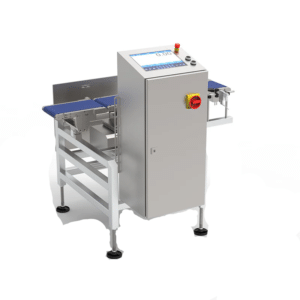
A typical industrial checkweigher includes:
- Infeed conveyor: Presents and spaces products before weighing.
- Weigh conveyor and load cell: Measures the weight of each individual pack.
- Controller and display: Stores product settings, displays results and records weighing data.
- Outfeed conveyor and reject mechanism: Removes or diverts products that fall outside the configured limits.
Depending on the system, products may be classified as underweight, acceptable or overweight. A reject mechanism, such as a pusher or air blast, can automatically remove packs outside the specified limits.
The most suitable reject mechanism depends on product weight, packaging format, production speed and how rejected products need to be handled.

A checkweigher can be used for sealed packs, trays, bags, cartons and other products, subject to the equipment and line setup. For case or pallet applications, a different weighing arrangement may be more suitable. We assess the product, packaging and production environment before recommending equipment.
How checkweighing supports pack weight compliance
The declared net quantity refers to the product, not its packaging. In practice, the checkweigher measures the complete pack, so your process needs a suitable way to account for packaging weight, or tare, where applicable. Tare variation and the way your equipment is configured can affect the reliability of the result.
For many pre-packed products in Great Britain, the applicable quantity-control requirements include the average system and the Packers’ Rules. In broad terms, these require that:
- The average actual contents of the relevant packages are not less than the declared quantity.
- The proportion of packages short by more than the tolerable negative error (TNE) is sufficiently small.
- No package is short by more than twice the TNE.
The exact requirements depend on the product, pack and applicable rules. The Office for Product Safety and Standards guidance on packaged-goods regulations explains the average system, equipment suitability and quantity-control systems. The Weights and Measures (Packaged Goods) Regulations 2006 apply in Great Britain; Northern Ireland has separate legislation. Check the requirements that apply to your products and markets.
A checkweigher is a useful part of a control system, but installing one does not by itself guarantee compliance. You still need suitable product settings, an appropriate checking process, equipment that is maintained and checked, and clear action when results fall outside your limits. Where your process uses sampling, the relevant records and checks must also be managed.
Why net weight control can protect your margins
Fillers are often set above the declared quantity to reduce the chance of underweight packs. The extra product above the declared amount is giveaway. Some allowance may be needed to manage process variation, but an excessive target can mean you are supplying more product than required across every run.
A checkweigher helps you see how the process is performing by showing individual pack results and, depending on the system, trends such as average weight and variation. This gives production teams a practical basis to investigate whether a filler is drifting or a product change has affected filling performance.
With a suitable setup, checkweighing can help you:
- Find and remove packs outside defined limits
- Spot changes in filling performance earlier
- Review average fill weights and product variation
- Make controlled adjustments to the filling process
- Reduce unnecessary overfilling while retaining an appropriate margin for process variation
The objective is not simply to lower the target weight. Your QA and production teams need to agree settings that support the applicable quantity-control requirements and the realities of your product and line.
Where does a checkweigher fit in the production line?
A checkweigher is most effective when it works as part of the wider packaging and inspection process. Its position depends on the pack format and the equipment around it, but it is commonly installed after filling and sealing, where it can assess each completed pack.
A typical inspection and packing sequence may include:
- Filling and sealing: A filler or portioning system makes up the product and closes the pack.
- Checkweighing: The checkweigher verifies pack weight and directs out-of-limit products to a controlled reject route.
- Foreign-body inspection: Metal detection or other inspection equipment checks for specific contamination risks.
- Labelling and coding: Product labels, dates, lot codes and barcodes are applied or verified.
- Traceability and despatch: Production and packaging data are linked to batch records, finished goods and customer orders.
The order can vary. For example, the metal detector may be installed before or after the checkweigher, depending on the product, packaging and line design. What matters is that each inspection stage has a clear purpose, suitable settings and a controlled response to rejects.
A combination system can bring metal detection and checkweighing together in one conveyor footprint. This may suit sites with limited space, but the system still needs to clearly identify why a product was rejected and how it should be handled. Separate reject routes, confirmation sensors and reject-bin controls can help operators manage weight and metal-detection events correctly.
Connect weight checks with labelling and traceability
Weight control does not confirm that a product has the correct label. A pack can meet its weight target and still carry the wrong product description, date, batch code or barcode. Labelling and code verification should therefore be considered alongside checkweighing, particularly where frequent product changeovers take place.
Integrating equipment with your labelling and traceability processes can help connect a check result to the correct product or production run. Depending on your setup, relevant data may include:
- Product recipe and weight limits
- Time, line and production run
- Pass or reject result and reason
- Operator actions and adjustments
- Batch or lot details linked to production records
This gives your team more useful information for reviews and investigations. It can also support the wider link between production, finished goods and despatch. Our food traceability framework explains how operational records can connect from goods-in through production and packaging to customer despatch.
For weighing and labelling at case level, our OCM-PRO weigh-price labeller supports weighing, labelling and traceability workflows. The right combination depends on your products, packaging and system requirements.

What to consider when choosing a checkweigher
Before specifying a checkweigher, review how your line operates today and what you need the system to do. Consider:
- Product and pack sizes, weights and formats
- Required line speed and product spacing
- Weight limits and how they will be set and reviewed
- Tare management and packaging variation
- Reject type, reject confirmation and bin controls
- Washdown conditions and hygienic design requirements
- Integration with fillers, conveyors, metal detection and labellers
- Data capture, reporting and links to ERP, QMS or traceability software
- Calibration, verification, preventative maintenance and operator training
Equipment performance depends on the installation and operating conditions as well as the weighing technology. A suitable machine needs to work with your product flow, available floor space, cleaning routine and line controls.
Equipment, integration and ongoing support
At Hub & Spoke, we supply and integrate checkweighers alongside industrial scales, inspection equipment and food manufacturing software. We can help you review a new line or assess an existing setup, including equipment selection, process integration, installation, commissioning and training.
We also provide ongoing service support for weighing equipment. Planned checks, servicing and calibration help your team monitor equipment condition and respond to issues. Our weighing equipment maintenance framework covers practical steps for planning that support.
A checkweigher should suit the product and work reliably with the rest of your line. If you are considering new equipment or reviewing weight control on an existing line, contact us with your requirements. We can discuss your products, throughput, inspection needs and integration priorities, then help you identify a suitable next step.