
For years, metal has been the familiar focus of foreign-body inspection in food production. But plastic is now the contaminant food manufacturers are most likely to name as a challenge—so it may be time to check whether your inspection set-up is looking for the full range of risks.
The FlexXray 2026 Foreign Material Contamination in Food Benchmark Report, based on a survey of food safety and manufacturing professionals, found that plastic has overtaken metal as the most cited foreign body for the first time in three years. Plastic was named by 37% of respondents as one of their top three most frequent foreign-material challenges, narrowly ahead of metal at 34%
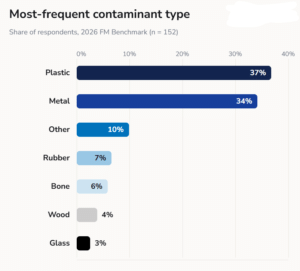
The report also notes that metal detection remains the most widely used inspection technology. Yet only a minority of respondents are very confident that their equipment catches everything. That does not mean metal detectors have stopped being valuable. It does mean that one inspection method may not be enough for every product, package and contaminant.
Why plastic can be difficult to detect
Inspection equipment works by identifying particular characteristics of a contaminant. The challenge is that different materials behave differently as they pass through a production line.
- Metal detectors and magnetic separation are designed to identify conductive or magnetic materials. They are not designed to detect non-conductive, low-density plastic..
- Sieves and screens provide a physical control based on particle size and shape. A thin, flexible plastic fragment may bend, align with an opening, or pass through.
- Conventional X-ray inspection relies on density contrast. Low-density plastic can have a similar density to the surrounding product, making it difficult to distinguish.
This is why the right question is not simply “Do we have a detector?” It is “Does each inspection method suit the product and the hazards we need to control?”
X-ray can add useful coverage, but it is not a universal answer. Performance depends on the contaminant, the product and the packaging. Your inspection plan should be based on those real operating conditions, not on the assumption that one machine can find everything.
Where X-ray inspection can add coverage
X-ray inspection can identify foreign bodies that are hard to detect using methods designed for conductive materials. It can inspect products in their packaging, which is useful when opening or unpacking products for inspection is not practical.
Two applications illustrate where this additional coverage can matter.
Glass detection in jars
Consider sauces packed in glass jars. A glass fragment can sit behind the jar glass and the product itself. It is not conductive, so there is nothing for a metal detector to trigger on.
Here, density imaging does the work. X-ray inspection assesses the contents and can help identify glass within the jar. The product and container are part of the inspection picture, so the system needs to be selected and set up for the actual jar, recipe and line conditions.
Metal detection in meat and fish
Meat and fish are dense products, and they are often inspected while still in a tray or film. The inspection method needs to work through the product and its packaging.
Metal detection remains an important control where it is suitable. But metal in dense, packaged product is also an application where X-ray earns its keep, providing another way to inspect the product through the pack. The aim is added coverage, not replacing a metal detector with X-ray.
Mekitec systems for food inspection
We supply the MEKITEC range of X-ray inspection systems for food producers and packers. The right option depends on your products, pack formats and line requirements.

- MEKI ONE is a compact, all-in-one X-ray inspection system for primary packaged food products. It can be configured to inspect products for foreign bodies including metal, glass, stones, bones and certain dense plastics, depending on the product, packaging and inspection conditions.
- MIDMEKI is designed for larger food products and trays containing multiple smaller items, helping producers inspect products at line speed while maintaining consistent inspection coverage.
You can find out more about our Mekitec X-ray inspection systems and discuss which option may suit your products. We can help assess the application and support the equipment through supply, installation and calibration.
Build an inspection plan around the line
Keep production and inspection records together
Inspection results are more useful when they can be considered alongside the production activity they relate to. Hub & Spoke can connect production data to our traceability software, so inspection and production records sit together and support more effective review and investigation.
Layer inspection methods
Use methods that address different risks rather than relying on a single device. Metal detection, X-ray inspection, sieves and screens can each have a role, depending on the product and the contaminant. Map the likely risks across goods-in, processing and packing, then check that your controls cover the relevant points.
Verify equipment and keep it maintained
A machine’s ability to inspect products needs to be checked regularly. Include calibration, verification and preventative maintenance in your planned routine. Keep the records that show what was checked, when it was checked and what action followed if a check identified a problem.
Train line teams
Equipment cannot replace attentive people. Train operators to carry out checks consistently, understand the required response to an alert and watch for issues the machines cannot identify. Clear responsibilities help make inspection part of normal production practice.
Keep production and inspection records together
Inspection results are more useful when they can be considered alongside the production activity they relate to. Hub & Spoke can connect production data to our traceability software so inspection and production records sit together. We supply, install and calibrate inspection equipment, and can support your team with practical guidance on using and maintaining it.

Inspection and weight control work together
Foreign-body inspection and weight control address different risks. Inspection helps identify unwanted material; checkweighing verifies product weight and completeness. They are complementary controls, not duplicates, and both can support consistent quality and compliance on a packing line.

We also provide checkweighers, weigh-price labellers and outer case marking solutions. For more on the role of in-line weight control, read our guide to how checkweighers help protect compliance and margins.
If you are reviewing inspection coverage, we can help you consider the product, pack, line process and checks your team needs to carry out. Contact Hub & Spoke to discuss a practical inspection and weighing set-up for your operation.
Phone: 0121 289 9648
Email: enquiries@foodservices.solutions
Website: foodservices.solutions
Q&A
Does X-ray replace our metal detector?
No. Metal detection is still the most widely used technology and it does its job well on dense, conductive material. X-ray adds the materials and situations a detector can’t cover, rather than replacing it.
Can X-ray find glass in a sealed jar of sauce?
X-ray inspection can detect glass fragments in jars of sauce, depending on the glass, product, fragment size and inspection system. Because the glass container and product are both part of the inspection image, the system needs to be properly selected and tested for the application.
We are mainly concerned about metal in meat and fish. Is X-ray inspection overkill?
X-ray inspection isn’t automatically overkill, but it isn’t necessarily required either. The decision depends on the product, packaging, potential contaminants and the performance of your existing metal detection system. An application assessment can help establish whether X-ray would provide worthwhile additional protection.
How often should the system be checked?
Verification is a routine part of running inspection kit, not a one-off. We cover calibration, verification, preventative maintenance and the records that show the checks were done.